


Introduction to Philippians
April 19, 2020
Text:
Acts 16:1-40; Philippians 1:1-2
Part 1 of the Series
Questions for Discussion
- Erik mentioned that Paul always speaks “grace” and “peace” to the churches when he writes to them. What is “grace”? It is more than just something we say at a meal. What does the word “grace” mean from Scripture?
- Paul defines the church as: the saints in Christ Jesus (saved individuals) at Philippi (a specific location) with the overseers and deacons (proper ministry leadership). How does this differ from other definitions of the church?
Structure of Ancient Epistles
You can see how well Paul uses the form of epistle to make his point. Here is the structure and the references in Philippians.
- Prescript – the names of the senders and recipients (1:1-2)
- Exordium (introduction) – usually a prayer of thanks and a statement of the sender’s situation and relationship to the recipient (1:3-26)
- Propositio (proposition) – the main issue or topic of the letter stated (1:27-30)
- Probatio (argumentation) – presenting evidence and reason validating the proposition (2:1-3:21)
- Peroratio (conclusion) – summarize the argument and make practical application (4:1-20)
- Postscript – farewell and a blessing (4:21-23)
A History of Philippi
Philippi’s history contributes to the culture of the people who lived there; but it does not mean that it all has direct implications on the epistle. Still, the history provides a “big” historical context that informs us asa we look at the “small” context of Paul and the New Testament church.
Early Settlement
In 360 BC, the island polis of Thasos established a colony called Krenides in the area that is now Philippi (Oiknomidis 2017, ). The site was treated as θασιον ηπειρo, “mainland Thasos” – a local source for agricultural and mineral goods. The discovery of gold and silver in the hills surrounding the site made it an enticing treat for Philip II of Macedon, who annexed the territory when he realized its value. This then prompted Athens and Thrace to attempt to claim the region for themselves, but Philip held them off. (Lane Fox 2011, 438–439)
According to Diodorus Siculus, Philip II saw the value of the gold mines and dramatically improved their ouput. Diodorus claims in what must be hyperbole that they were producing 1,000 talents (or about 26,200kg) of gold per year. 1 Whatever the actual amount produced by the mines, the gold of Philippi helped fund Philip and Alexander’s bold military expeditions.
At this point in its history, it might be incorrect to refer to Philippi as a city. It was not a Greek polis. Philip established it instead a “free city” under his direct control. It was more of a fortified mining settlement, situated on the southernmost rise of the foothills of the Pangaion Mountains. According to Appian, the city occupied the entire top of the hill (Appian, The Civil Wars 4.105) which gave it tremendous security but limited expansion.
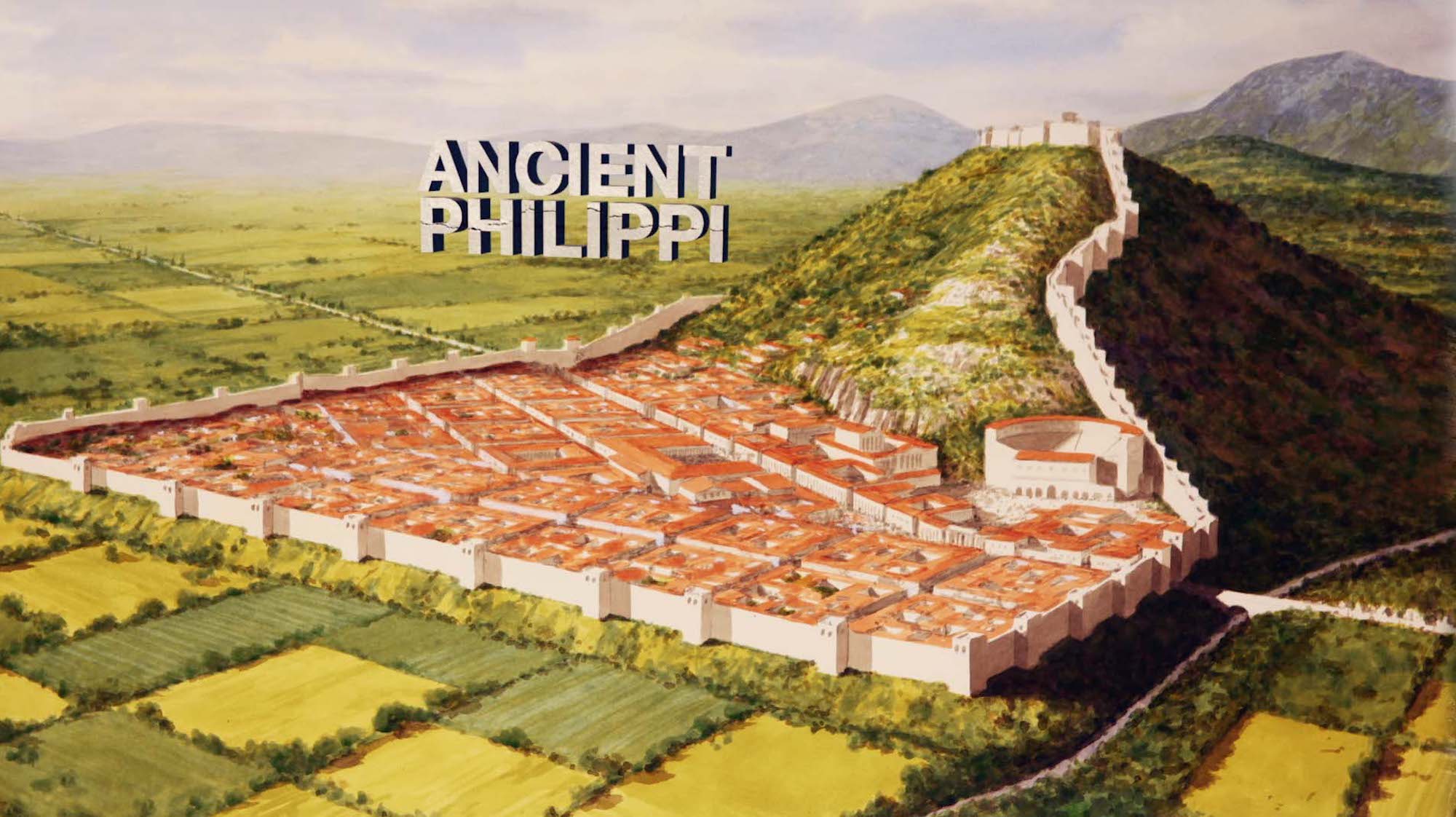
Artist’s Impression of Roman Philippi – https://drivethruhistoryadventures.com/philippi-of-macedonia/
Roman Philippi
The Romans conquered Macedonia in 168 BC, and Philippi became one of their primary mining sites in the Eastern Mediterranean. It was something of a backwater, valued for the resources it provided but little accounted for until after the murder of Julius Caesar. It was on the plains between the mountains and the Aegean that Octavius and Antony’s forces finally crushed the conspirators’ armies and ushered in the era of what would become the Roman Empire.
Once in power, Octavius declared Philippi a colony. The city no longer was under local magistrates and law. He settled somewhere between 1,000 and 2,000 veterans there, establishing Roman law and securing Macedonia. The Romans then built a great trade route from the Adriatic to the Hellespont called the Via Egnatia. Philippi sat more or less in the middle of the 700 mile long road, just a short journey to a good harbor at Neapolis.
Philippi’s population probably did not live in the hilltop fortress. Most of the Roman ruins are in the plains below. The permanent population was probably around 10,000 at the time of the New Testament, although any estimate is circumstantial. The capital of the region was to the west at Amphipolis, and Luke’s reference to Philippi as πρώτης μερίδος is probably meant to indicate it was the first city he and Paul visited in Macedonia, rather than political prominence (Ac 16:12).
Paul in Philippi
After a supernatural vision calling him to Macedonia, Paul crossed the Aegean from Troas. His vessel sailed north to the island of Samothrace. Then after a western crossing of the Thracian Sea to the island of Thasos, his ship would have rounded the island and headed north to the harbor of Neapolis. From there, it is an 8 mile walk to Philippi.
Paul and his companions probably made the crossing early in the week and when the sabbath arrived, they went to the small river that flows by the city to the west. They assumed there would be a place of prayer there, indicating that there was not a substantial Jewish presence in the city. Anywhere ten Jewish men were present, a synagogue could be formed; and there are synagogues dotting the cities of the empire. Instead, Paul encounters a group of women gathered by the river.
This indicates that the city did not have a significant Torah-observant Jewish presence. There may have been Jewish men, but they were probably Roman legionaries and they could not observe the Torah properly. So, the early church in Philippi was founded in the house of a woman, Lydia. More about her next week.
Bibliography
Lane Fox, Robin J., ed. Ancient Macedon: Studies in the Archaeology and History of Macedon, 650 BC – 300 AD. Leiden: BRILL, 2011.
Oikonomidis, Dimitrios, Michael Vavelidis, Vasilios Melfos and Mariam Artashova. “Searching for ancient gold mines in Filippoi area, Macedonia, Greece, using Worldview–2 satellite imagery.” Geocarto International, 32, no 1 (2017): 87–96.
Artist’s Impression of Roman Philippi – https://drivethruhistoryadventures.com/philippi-of-macedonia/
- This estimate seems extravagant since it would be four or five times the output of the most productive modern mine in the world, the South Deep Mine in South Africa. ↩︎
Leave a Reply