
Down the street from my house, they are building a Lowe’s. This would not be a big deal if it weren’t for the fact that we already have a Loew’s. We also have two Home Depots, three Wal-marts, two Targets, three Hannaford’s supermarkets and at least fifty Dunkin’ Donuts. (I’m not kidding either).
Why do I care about another Lowe’s? Because we already have one. Why, I asked myself, do we need yet another home goods store? Don’t we have enough? Won’t people just drive to the other one? That got me thinking about churches, and that (as they say) is a dangerous thing.
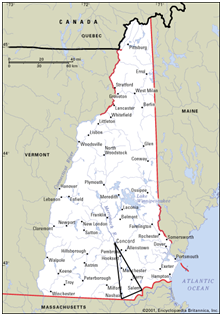
We live in the middle of a triangle that contains most of the people in New Hampshire. If you look at a map of New Hampshire and find the towns of Nashua and Salem (both are on the Massachusetts border) and then locate Concord north of both, you can draw the triangle I am speaking of. That tiny bit of the state is where almost all the population can be found. The population of the entire state is only 1.3 million, and 515,988 of them live inside that triangle. (That’s 40% for your math geniuses.)
The Megachurch Phenomenon
An interesting phenomenon has occurred in the last thirty years or so which has facilitated the growth of the megachurches that now dot the North American landscape. The suburbanization of the large cities in the nation and the development of a commuter mentality have been part of the development of the megachurch but not the only contributors. The Hartford Institute for Religious Research has compiled a list of over 1,300 Protestant churches with an average weekly attendance around or greater than 2,000 people. By size, the top ten are:
- Lakewood Church, Houston, Texas: 47,000
- Willow Creek Community Church, S. Barrington, Illinois: 23,500
- Second Baptist Church, Houston, Texas: 23,200
- Saddleback Church, Lake Forest, California: 22,000
- LifeChurch, Edmond, Oklahoma: 19,900
- Southeast Christian Church, Louisville, Kentucky: 18,000
- Northpoint Community Church, Alpharetta, Georgia: 17,700
- Thomas Road Baptist Church, Lynchburg, Virginia: 17,500
- Calvary Chapel, Ft. Lauderdale, Florida: 17,000
- The Potter’s House, Dallas, Texas: 17,000
Included in the list are Grace Community Church (John Macarthur, 7,500) and the Campus Church of Pensacola Christian College (5,500) as well as Mars Hill Church in Seattle Washington (now about 7,500).
If you take the time to peruse the websites of these churches, you discover that they are mostly located in the suburbs of these large cities like Houston and Chicago. Some are between two larger metropolitan areas (like Saddleback Church), but few are inside cities.
Beyond that, most have a membership that is spread out over a large geographic area. People generally live within a circumference of twenty to forty miles. Since megachurch buildings are generally located within easy highway access and with adequate parking, people are willing to travel – even those who might be attending for the first time.
And what about the Small Church?
When you look at smaller local churches, you would assume that the geographic dispersal would be much smaller, but such is not the case.
Our church, composed of approximately 50 people, is spread out over a seemingly enormous space.
- The Greater Manchester region is composed of the city and nine outlying towns: Auburn, Bedford, Candia, Derry, Goffstown, Hooksett, Litchfield, Londonderry, and Merrimack. Our church is scattered over all these towns.
- Manchester alone is 33 square miles; the region comprises almost 320 square miles. There are over 265,000 people in the nine towns.

What does this mean? It means that the average family in our church will drive 12.73 miles one way to our worship gatherings on Sundays. The reality is that when I checked the traveling times using Google Earth, I found that only four families lived within a reasonable walking distance (less than 3 miles).
Now, this is all fine and good for people who are already Christians and are interested in church. They come to our church because of doctrine or music or preaching or even programs, but they have a bias toward this. They will travel a greater distance than an unchurched person would ever think of traveling.
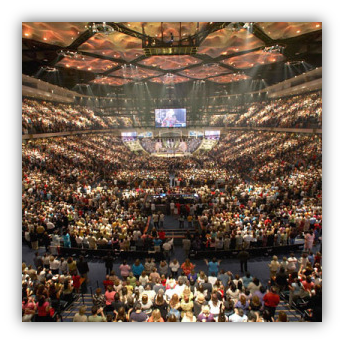
In fact, established Christians will tolerate a great deal when it comes to a church. They don’t mind poor parking conditions or an uncleaned auditorium. They don’t care what color walls are (unless the color is being debated in a business meeting). But what would people who do not know Jesus think? They might travel twenty miles to visit a megachurch worship service (to the right), but what would motivate them to join a group of 50 who meet twenty miles away?
Whether we have good doctrine or not matters, but if our church is not accessible to people who need to hear the message of Jesus, then it is useless.
So the challenge before us is simple. How does the local church think regionally? How should we adapt to this phenomenon to continue to make an impact for the kingdom?

Hi – Google’s Blog alert sent me to this post because of your reference to thinking regionally. You might find some resources for your discussion at Regional Community Development News. http://regional-communities.blogspot.com/ Please visit, check the tools and consider a link. I’ll include a link to this post in the June 11 issue. Tom